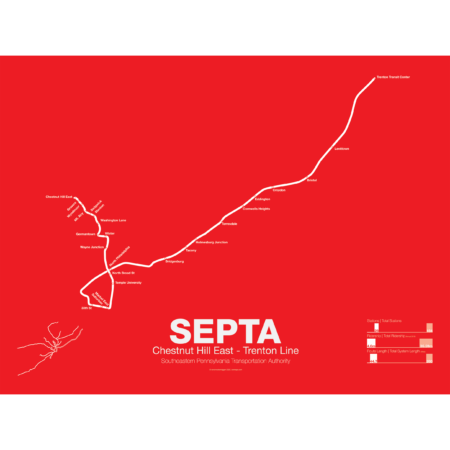
Printed on Satin finish 80# cover stock – 220 GSM. Made in the USA! Standard production time is 5 days. Allow more time for shipping.

SEPTA Regional Rail R7: Chestnut Hill East – Trenton Line
Price range: $30.00 through $80.00
Additional information
| Weight | 1 lbs |
|---|---|
| Dimensions | 3 × 3 × 24 in |
| Size | Framed 18"x24", 18" x 24", 24" x 36 |
Related products
-
 Price range: $30.00 through $80.00
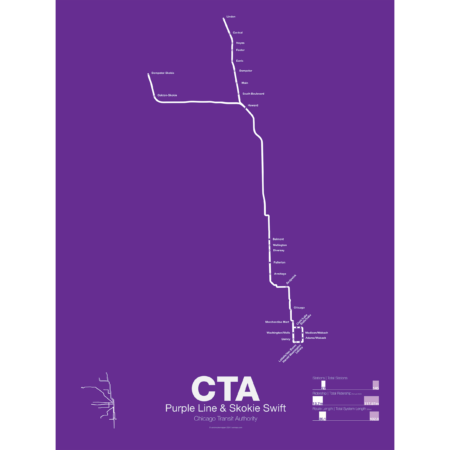
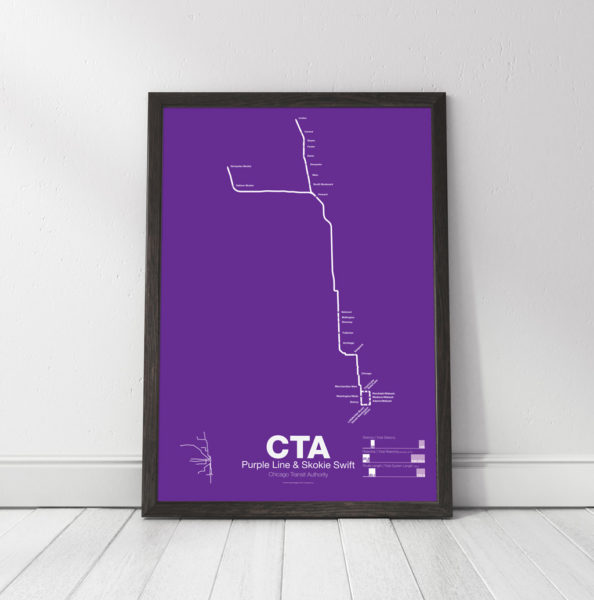
The Purple Line began as part of the Northwestern elevated, a bit of a misnomer as the line ran mostly at street level until it was expanded onto a 4 track elevated embankment in 1928. The line was extended to Evanston in 1908 and Wilmette in 1912. After 1928 the line began running express from Howard station to the Loop. In 1949 when the CTA took over operations the line was rerouted through the State St Subway as part of a new north-south route. This service was eventually replaced by the Red Line. Today the Purple Line runs from Linden to Howard days and express to the Loop at rush hour.
The Yellow Line, formerly known as the Skokie Swift, began as an interurban high speed line from Howard terminal to Dempster St in Niles Center (now known as Skokie). The line ceased operations in 1963 but was bought by the CTA and service restarted in 1964 with intermediate stations closed. The Yellow Line is the only line in the CTA which doesn’t run to downtown Chicago. In 2012 an infill station at Oakton was opened and a northern extension to Old Orchard Mall is being studied.
Printed on Satin finish 80# cover stock – 220 GSM. Made in the USA! Standard production time is 5 Days. Please add more time for shipping.
Select options This product has multiple variants. The options may be chosen on the product page -
 Price range: $30.00 through $80.00
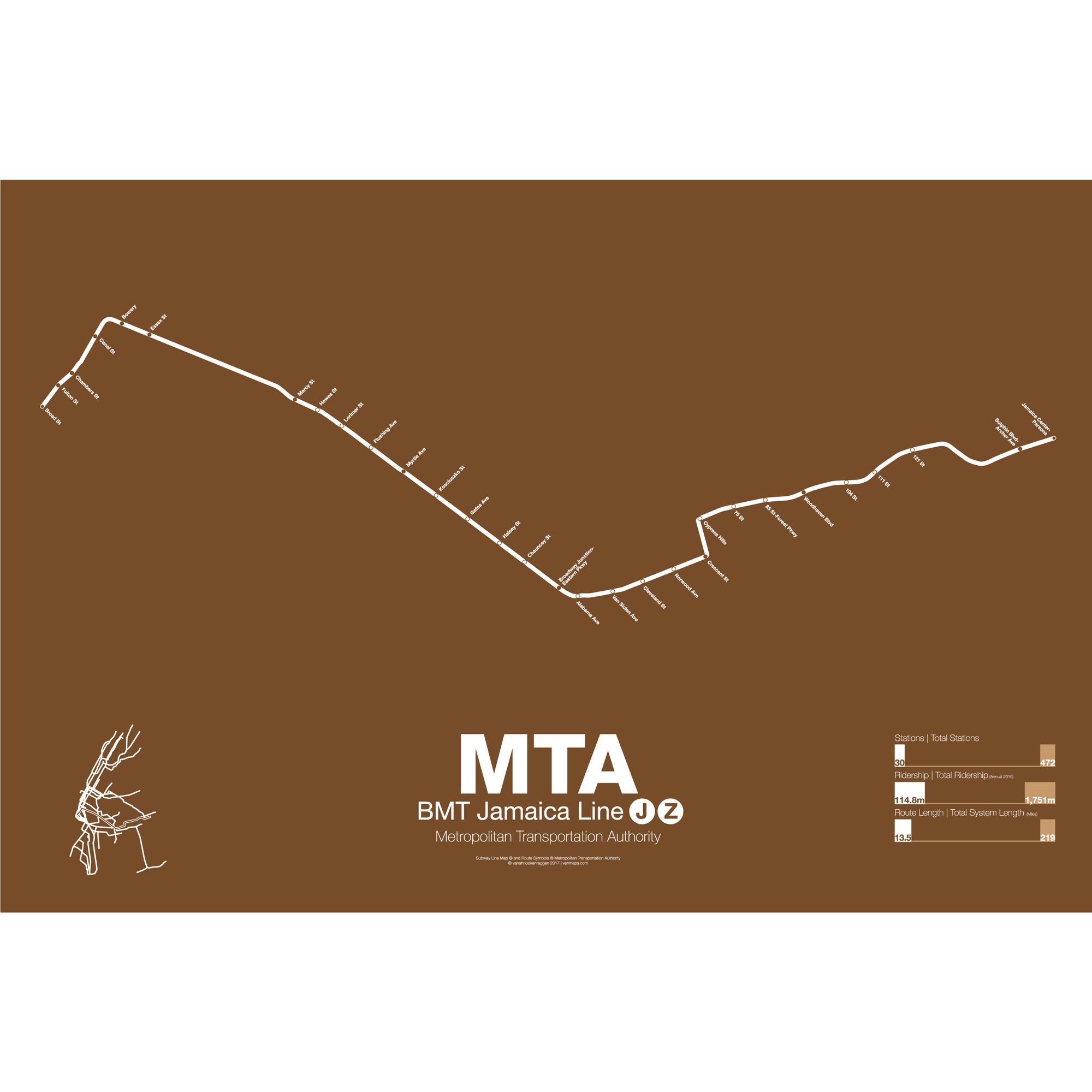
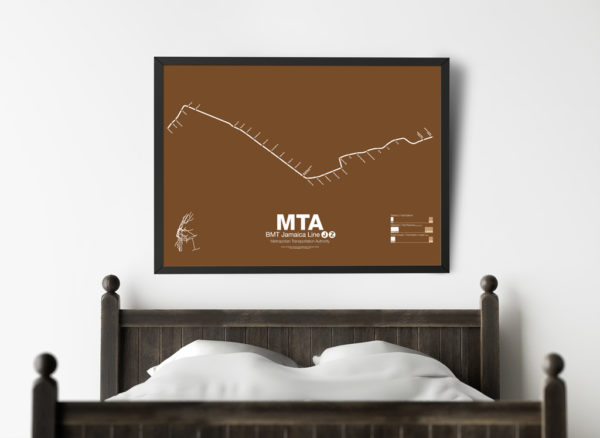
The BMT Jamaica line is the second oldest continually operated rapid transit line in all of New York City (behind the Franklin Ave shuttle). Originally an elevated train from Driggs Ave in Williamsburg to Gates Ave where it connected with the existing Lexington Ave elevated (not to be confused with the Lexington Ave subway in Manhattan). Opened in 1885 the line was electrified and expanded east to Broadway Junction (1893) then to Jamaica (1913). When the Williamsburg Bridge opened in 1903 it was extended to an underground terminal at Delancey and Essex St on the Lower East Side.
In 1918 a subway was opened connecting the existing terminal at Essex St to a new terminal downtown at Chambers St under the newly constructed Municipal Building. While the elevated line in Brooklyn was only 3 tracks (2 in many places) the new subway under Delancey and Centre Sts was 4 tracks and allowed for express service. The subway was further extended to connect to the new BMT Broadway line subway for service back into Brooklyn.
Three trains run along the BMT Jamaica line. The J/Z runs local from Broad St in Manhattan weekdays (rush hours) and Chambers St all other times to Marcy Ave. After Marcy Ave at rush periods the J runs express to Myrtle Ave and Broadway Junction (running local all other times). After Broadway Junction the J and Z trains operate “skip-stop” service where each train alternates stops. Thus each train only stops at half of the stations. The original elevated track through Jamaica Center was demolished in the 1979 and service was rerouted along the new subway under Archer Ave.
M trains once ran along an elevated line, the Myrtle Ave elevated, from downtown Brooklyn out to Middle Village-Metropolitan Ave. In the 1950s the section of track from downtown to Broadway (Brooklyn) was torn down and service was run from Broad St to Middle Village along the northern portion of the tracks. The M train made this run until 2010 when it was rerouted through the Chrystie St cut to run as local service along 6th Ave. On nights and on weekends the M train is cut back to a shuttle service from Myrtle Ave to Middle Village.
Printed on Satin finish 80# cover stock – 220 GSM. Made in the USA! Standard production time is 5 days. Allow more time for shipping.
Select options This product has multiple variants. The options may be chosen on the product page -
 Price range: $30.00 through $80.00
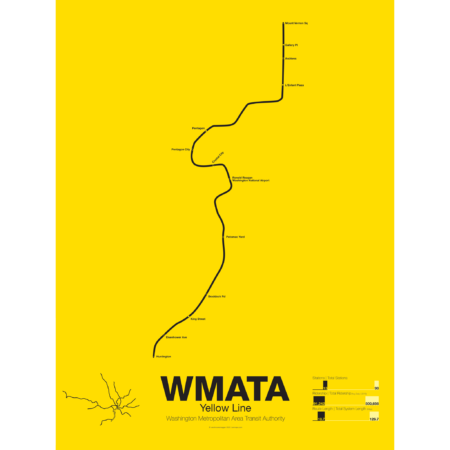
The Yellow Line was the fourth service of the Washington Metro to open and is today the shortest. Opened in 1983 connecting National Airport to Gallery Place the route acts as a bypass around downtown Arlington.
The route of the Yellow Line has deviated from the original planned route more than any other line. In December of 1983 the line was extended south to Huntington but was originally to run out to Franconia-Springfield (which didn’t open until 1997). A shortage of train cars caused this switch because the Yellow Line required fewer cars than the Blue Line which was routed out to Franconia-Springfield instead.
The Yellow Line was extended north to U St in 1991 but the final extension to Greenbelt was delayed because the original alignment along the median of the North Central Freeway was changed when that freeway was canceled. A new subway connection from U St to Fort Totten, the route subject to much controversy, was eventually opened in 1999 for Green Line service and in 2006 the Yellow Line was extended to Fort Totten.
Today the Yellow Line shares most of its route through Virginia with the Blue Line and all of its route through D.C. with the Green Line.
Printed on Satin finish 80# cover stock – 220 GSM. Made in the USA! Standard production time is 5 Days. Please add more time for shipping.
Select options This product has multiple variants. The options may be chosen on the product page -
 Price range: $30.00 through $80.00
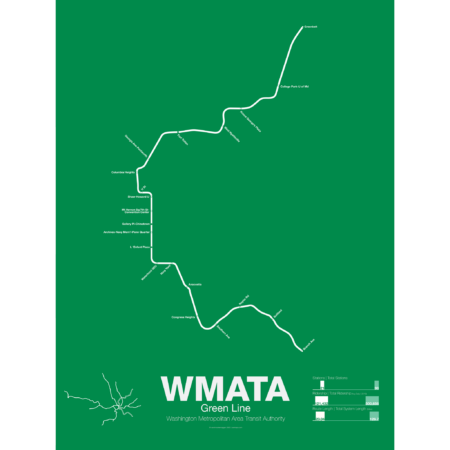
The Green Line was the final section of the original Washington Metro to open with trains not running until December 1991. While planning for the Green Line began at the same time as the rest of the system it was decided in 1977 to develop the route last. This decision sparked much controversy because the Green Line runs through areas of the city which are the poorest and most transit dependent.
Legal and funding issues dogged construction of the line. Station locations were also subject to much controversy and the ultimate route changed often. The northern section was to run in the median of the North Central Freeway but had to be changed when the freeway was canceled.
The Green Line shares its route through central D.C. with the Yellow Line. The first section ran from U St to Anacostia. Due to controversy over the route from U St to Fort Totten a small section of the Green Line from Fort Totten to Greenbelt opened first in 1993 with no physical connection to the other section of Green Line.
While the final section of subway from U St to Fort Totten was under construction some Green Line trains ran along the Red Line from West Hyattsville to Farragut North using a single non-revenue track connecting each line. In 1999 the connection between U St and Fort Totten was finally opened. In 2001 the Green Line was extended south to Branch Ave, thus completing the originally planned system 25 years after the first section was opened and 46 years after planning began.
Printed on Satin finish 80# cover stock – 220 GSM. Made in the USA! Standard production time is 5 Days. Please add more time for shipping.
Select options This product has multiple variants. The options may be chosen on the product page