Printed on Satin finish 80# cover stock – 220 GSM. Made in the USA! Standard production time is 5 days. Allow more time for shipping.
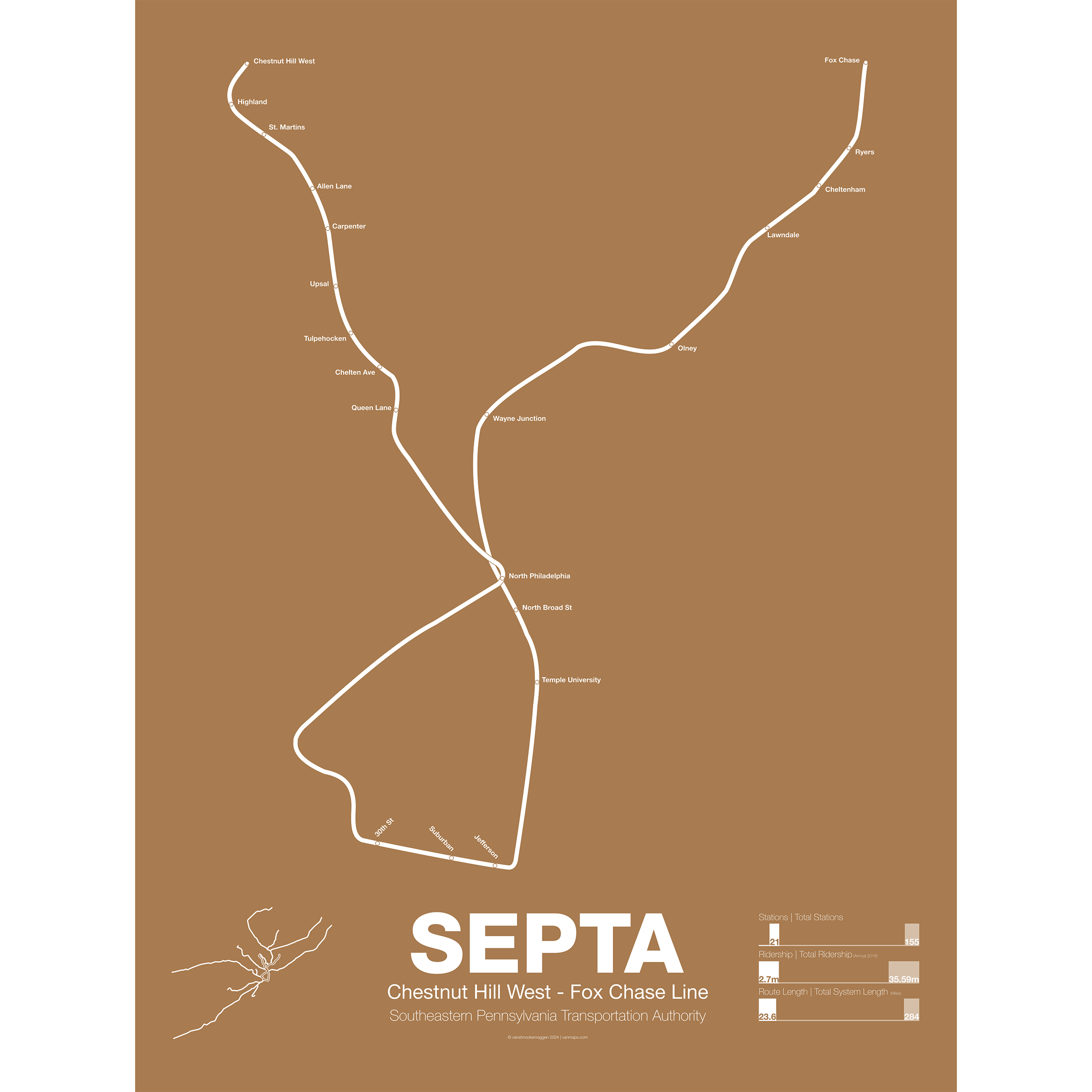
SEPTA Regional Rail R8: Chestnut Hill West – Fox Chase Line
Price range: $30.00 through $80.00
Additional information
| Weight | 1 lbs |
|---|---|
| Dimensions | 18 × 1 × 24 in |
| Size | Framed 18"x24", 18" x 24", 24" x 36 |
Related products
-
 Price range: $30.00 through $80.00
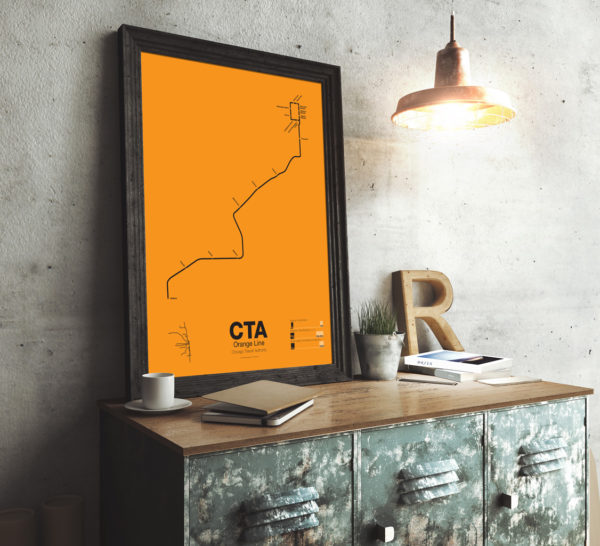
First proposed in the 1930s but only opened in 1993 the Orange Line serves the southwest section of Chicago and terminates at Midway Airport. Funding for the line was secured after the cancellation of the controversial Crosstown Expressway. For much of the route the Orange Line runs parallel to CSX and Conrail tracks but connects to the Loop in downtown Chicago. The original terminal at Ford City Mall was cut back due to cost savings but current studies are underway to extend the Orange Line past Midway to the mall.
Printed on Satin finish 80# cover stock – 220 GSM. Made in the USA! Standard production time is 5 Days. Please add more time for shipping.
Select options This product has multiple variants. The options may be chosen on the product page -
 Price range: $30.00 through $80.00
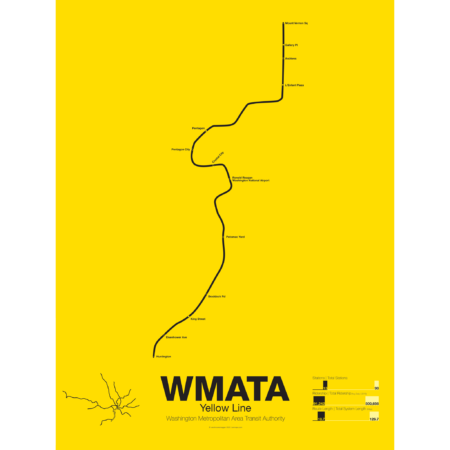
The Yellow Line was the fourth service of the Washington Metro to open and is today the shortest. Opened in 1983 connecting National Airport to Gallery Place the route acts as a bypass around downtown Arlington.
The route of the Yellow Line has deviated from the original planned route more than any other line. In December of 1983 the line was extended south to Huntington but was originally to run out to Franconia-Springfield (which didn’t open until 1997). A shortage of train cars caused this switch because the Yellow Line required fewer cars than the Blue Line which was routed out to Franconia-Springfield instead.
The Yellow Line was extended north to U St in 1991 but the final extension to Greenbelt was delayed because the original alignment along the median of the North Central Freeway was changed when that freeway was canceled. A new subway connection from U St to Fort Totten, the route subject to much controversy, was eventually opened in 1999 for Green Line service and in 2006 the Yellow Line was extended to Fort Totten.
Today the Yellow Line shares most of its route through Virginia with the Blue Line and all of its route through D.C. with the Green Line.
Printed on Satin finish 80# cover stock – 220 GSM. Made in the USA! Standard production time is 5 Days. Please add more time for shipping.
Select options This product has multiple variants. The options may be chosen on the product page -
 Price range: $30.00 through $80.00
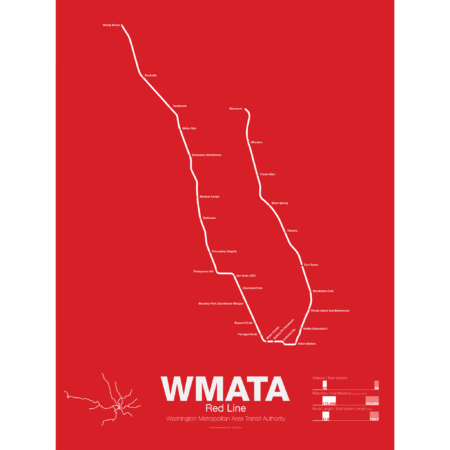
Breaking ground December 9th, 1969 the Red Line was the first section of the Washington Metro to open, from Farragut North to Rhode Island Ave, in 1976 in conjuncture with the nations Bicentennial. Over the next few years the line was extended to Dupont Circle and Silver Springs, MD and throughout the 1980s was slowly expanded to Shady Grove, MD and Wheaton, MD with a final extension to Glenmont opening in 1998.
The Red Line is the most used line in the WAMA system and the only line that doesn’t share a route with another line. A two track line, all but four of the stations are single central platforms. Most of the line is underground; however, the eastern branch from Union Station to Silver Springs and the western branch from White Flint to Shady Grove runs above ground along the Baltimore and Ohio Railroad right-of-way.
Printed on Satin finish 80# cover stock – 220 GSM. Made in the USA! Standard production time is 5 Days. Please add more time for shipping.
Select options This product has multiple variants. The options may be chosen on the product page -
 Price range: $30.00 through $80.00
The Blue Line started off as a trolley tunnel to connect Scollay Sq. in downtown Boston to Maverick Sq. in East Boston. It holds the distinction as the first underwater transit tunnel (under a major body of water) opening in 1904. Initial plans called for it to be connected to the Green Line to form a subway trolley network connection all points north, east, south, and west. However, in 1924, the line was converted to heavy rail and extended to Bowdoin Sq. The Blue Line diverted traffic away from East Boston ferries which, ironically, helped bring the demise to the Atlantic Ave elevated line.
Until the 1950s the Blue Line was connected to the Red Line at Charles St so that Blue Line trains could be serviced at the Red Line train shops in Harvard Sq. In 1952 the Blue Line was extended to Suffolk Downs along the abandoned Boston, Revere Beach and Lynn Railroad and two years later extended to Revere where it still terminates at Wonderland.
Printed on Satin finish 80# cover stock – 220 GSM. Made in the USA! Standard production time is 5 Days. Please add more time for shipping.
Select options This product has multiple variants. The options may be chosen on the product page