

Printed on Satin finish 80# cover stock – 220 GSM. Made in the USA! Standard production time is 5 Days. Please add more time for shipping.
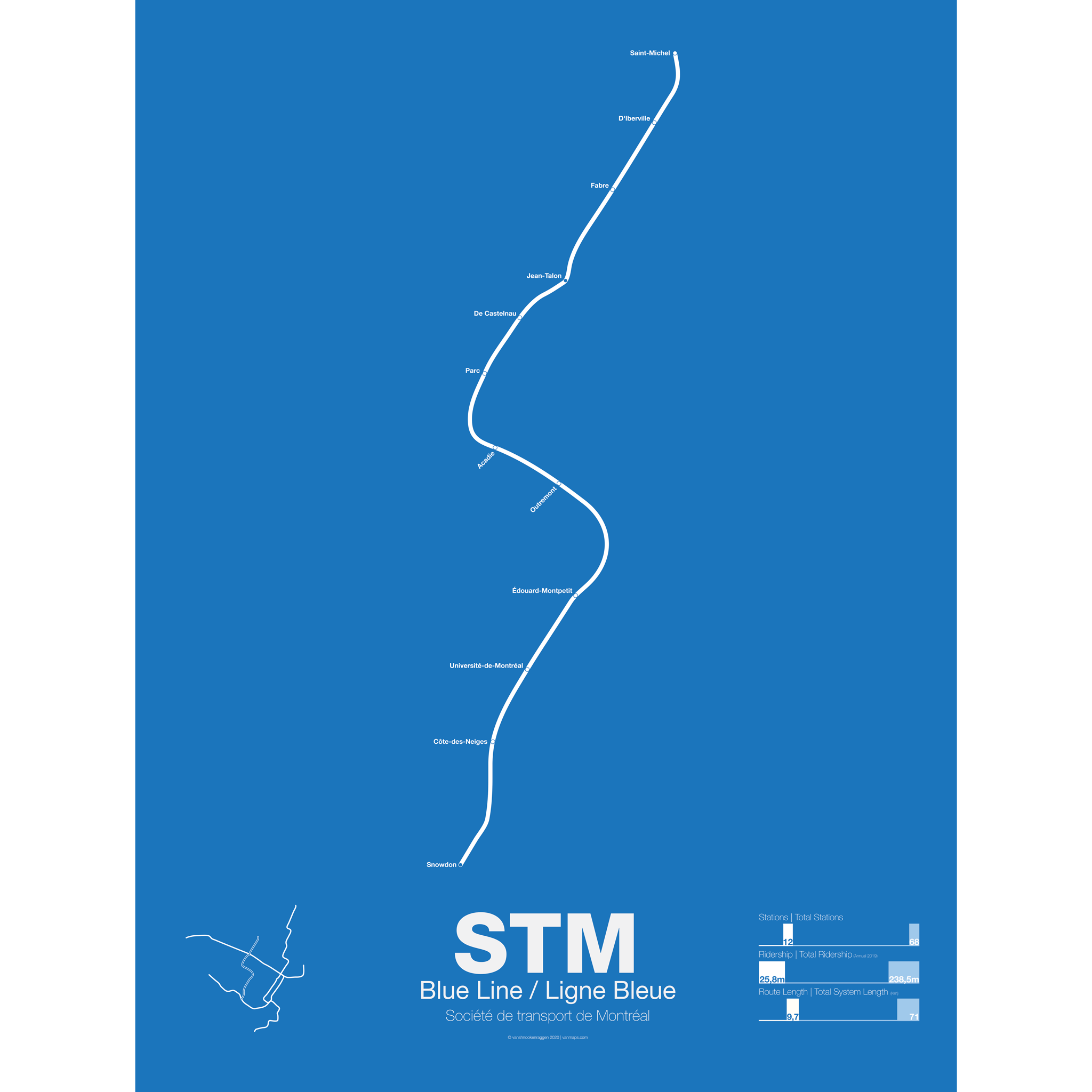

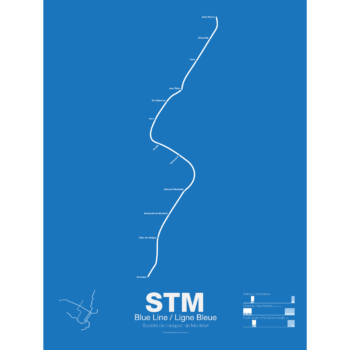
STM Blue Line / Ligne Bleue Poster
Price range: $30.00 through $80.00
Additional information
| Weight | N/A |
|---|---|
| Dimensions | N/A |
| Size | Framed 18"x24", 18” x 24”, 24” x 36” |
Related products
-
 Price range: $30.00 through $80.00
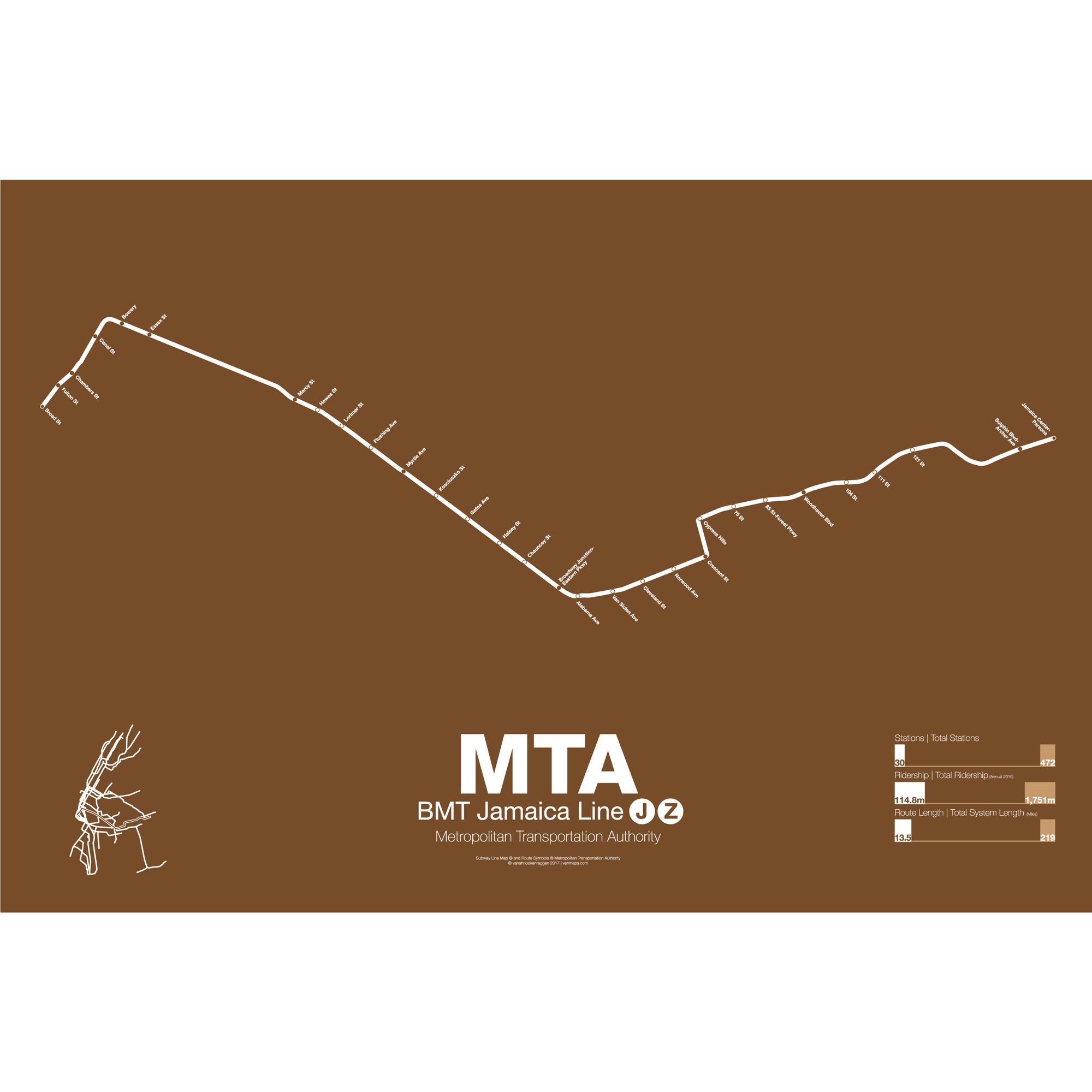
The BMT Jamaica line is the second oldest continually operated rapid transit line in all of New York City (behind the Franklin Ave shuttle). Originally an elevated train from Driggs Ave in Williamsburg to Gates Ave where it connected with the existing Lexington Ave elevated (not to be confused with the Lexington Ave subway in Manhattan). Opened in 1885 the line was electrified and expanded east to Broadway Junction (1893) then to Jamaica (1913). When the Williamsburg Bridge opened in 1903 it was extended to an underground terminal at Delancey and Essex St on the Lower East Side.
In 1918 a subway was opened connecting the existing terminal at Essex St to a new terminal downtown at Chambers St under the newly constructed Municipal Building. While the elevated line in Brooklyn was only 3 tracks (2 in many places) the new subway under Delancey and Centre Sts was 4 tracks and allowed for express service. The subway was further extended to connect to the new BMT Broadway line subway for service back into Brooklyn.
Three trains run along the BMT Jamaica line. The J/Z runs local from Broad St in Manhattan weekdays (rush hours) and Chambers St all other times to Marcy Ave. After Marcy Ave at rush periods the J runs express to Myrtle Ave and Broadway Junction (running local all other times). After Broadway Junction the J and Z trains operate “skip-stop” service where each train alternates stops. Thus each train only stops at half of the stations. The original elevated track through Jamaica Center was demolished in the 1979 and service was rerouted along the new subway under Archer Ave.
M trains once ran along an elevated line, the Myrtle Ave elevated, from downtown Brooklyn out to Middle Village-Metropolitan Ave. In the 1950s the section of track from downtown to Broadway (Brooklyn) was torn down and service was run from Broad St to Middle Village along the northern portion of the tracks. The M train made this run until 2010 when it was rerouted through the Chrystie St cut to run as local service along 6th Ave. On nights and on weekends the M train is cut back to a shuttle service from Myrtle Ave to Middle Village.
Printed on Satin finish 80# cover stock – 220 GSM. Made in the USA! Standard production time is 5 days. Allow more time for shipping.
Select options This product has multiple variants. The options may be chosen on the product page -
 Price range: $30.00 through $80.00
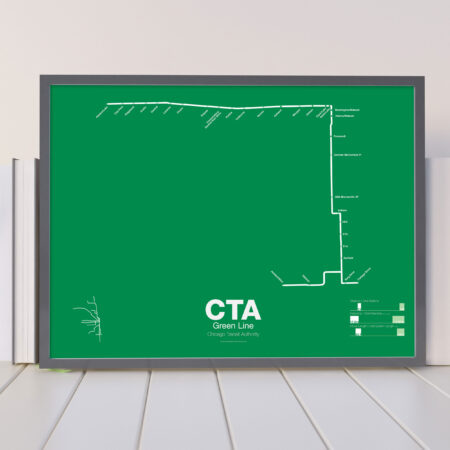
The Green Line is the modern combination of two of the oldest sections of the Chicago “L”. The South Side elevated opened in 1892 to serve the Columbian Exposition in 1893 and led to a building boom on the south side of Chicago. A number of branches were added to the line, to Englewood, Normal Park, Kenwood, and the Stock Yards. Today only the Englewood and Jackson Park branches remain while a number of stations have been closed due to low ridership.
The Lake St elevated was Chicago’s second elevated line opening in 1893. When the State St Subway opened in 1947 it was originally used by the South Side trains to connect to the north side and when the Dan Ryan Branch opened in 1969 it was used by the Lake St Line. In 1993 the CTA reorganized routings and color coded the new Lake St-South Side Lines as the Green Line.
Printed on Satin finish 80# cover stock – 220 GSM. Made in the USA! Standard production time is 5 Days. Please add more time for shipping.
Select options This product has multiple variants. The options may be chosen on the product page -
 Price range: $30.00 through $80.00
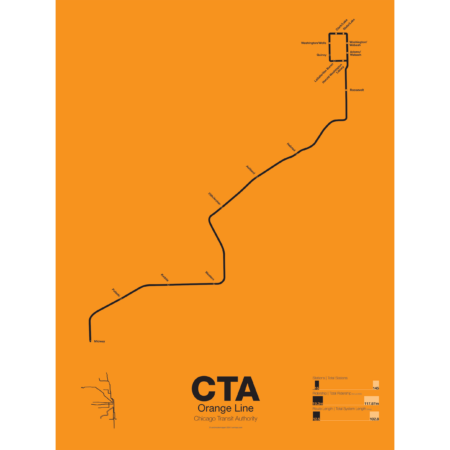
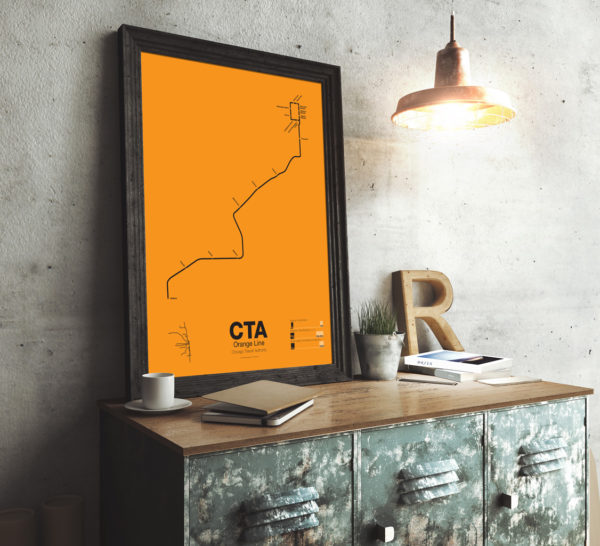
First proposed in the 1930s but only opened in 1993 the Orange Line serves the southwest section of Chicago and terminates at Midway Airport. Funding for the line was secured after the cancellation of the controversial Crosstown Expressway. For much of the route the Orange Line runs parallel to CSX and Conrail tracks but connects to the Loop in downtown Chicago. The original terminal at Ford City Mall was cut back due to cost savings but current studies are underway to extend the Orange Line past Midway to the mall.
Printed on Satin finish 80# cover stock – 220 GSM. Made in the USA! Standard production time is 5 Days. Please add more time for shipping.
Select options This product has multiple variants. The options may be chosen on the product page -
 Price range: $30.00 through $80.00
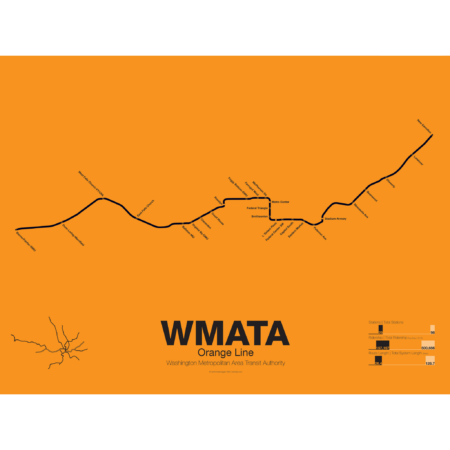
The Orange Line was the third leg of the Washington Metro to open, though service began running in 1978 as a one way service along the existing Blue Line from New Carrollton to National Airport. It wasn’t until a year later in 1979 that the Orange Line was extended out to Ballston when it began running in both directions. In 1986 the line was extended out to Vienna. Plans at the time to reroute the line through the fast developing Tysons Corner were eventually dropped to prevent a five year delay in construction.
These plans were resurrected with the Silver Line being built through Tysons Corner on its way to Dulles Airport. The Orange Line through Virginia runs along the median of Interstate 66 from Vienna to Falls Church. Originally the line was to run along the median of I-66 through Arlington but city planners rerouted it through downtown Arlington which helped stimulate dense residential development in central Arlington.
From Roslyn to Stadium-Armory the Orange and Blue lines share their downtown subway tunnel and split after ascending to the surface on a bridge over the Anacostia River. From here the Orange Line runs alongside the CSX/Amtrak ROW to New Carrollton.
Printed on Satin finish 80# cover stock – 220 GSM. Made in the USA! Standard production time is 5 Days. Please add more time for shipping.
Select options This product has multiple variants. The options may be chosen on the product page
Reviews
There are no reviews yet.