Printed on Satin finish 80# cover stock – 220 GSM. Made in the USA! Standard production time is 5 days. Allow more time for shipping.
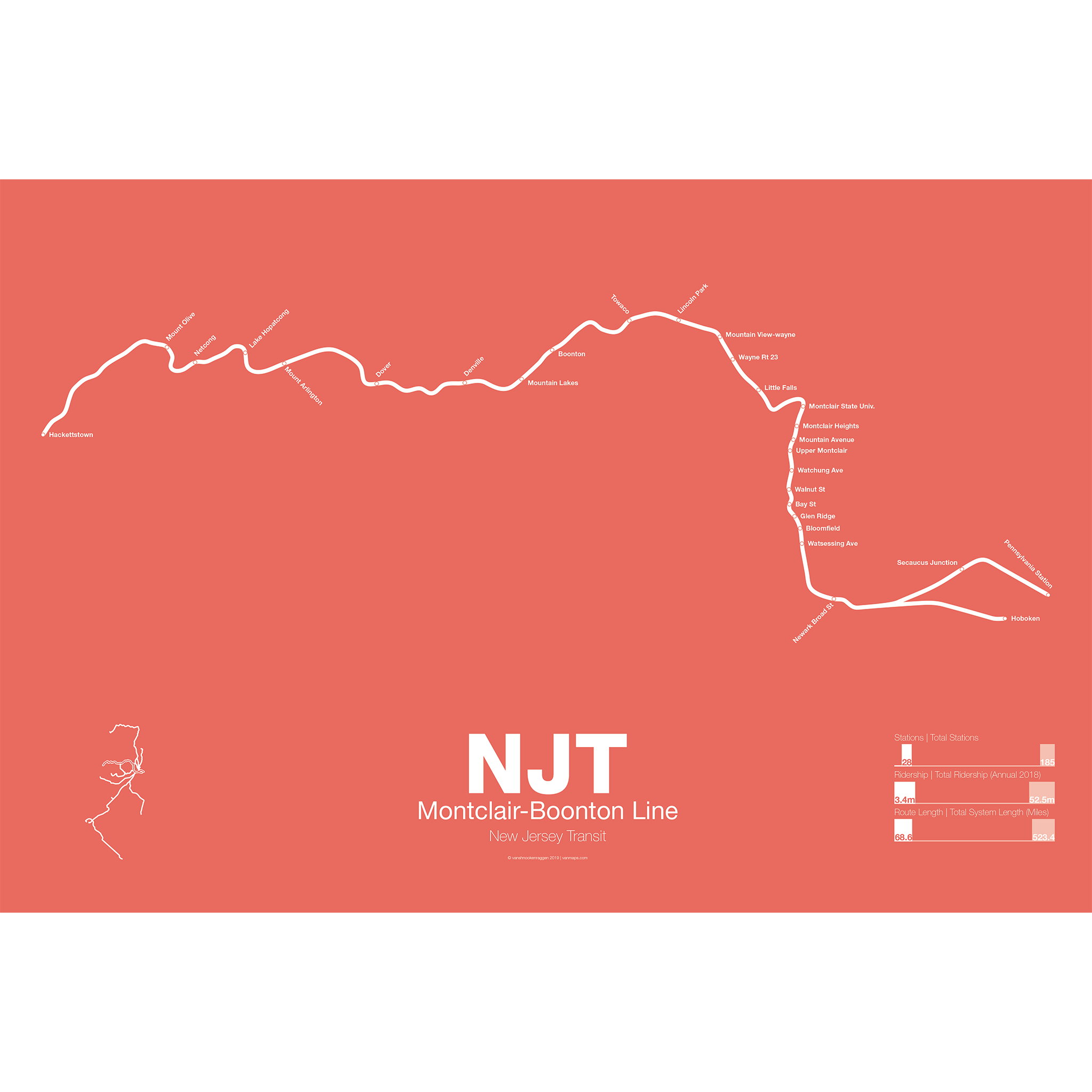
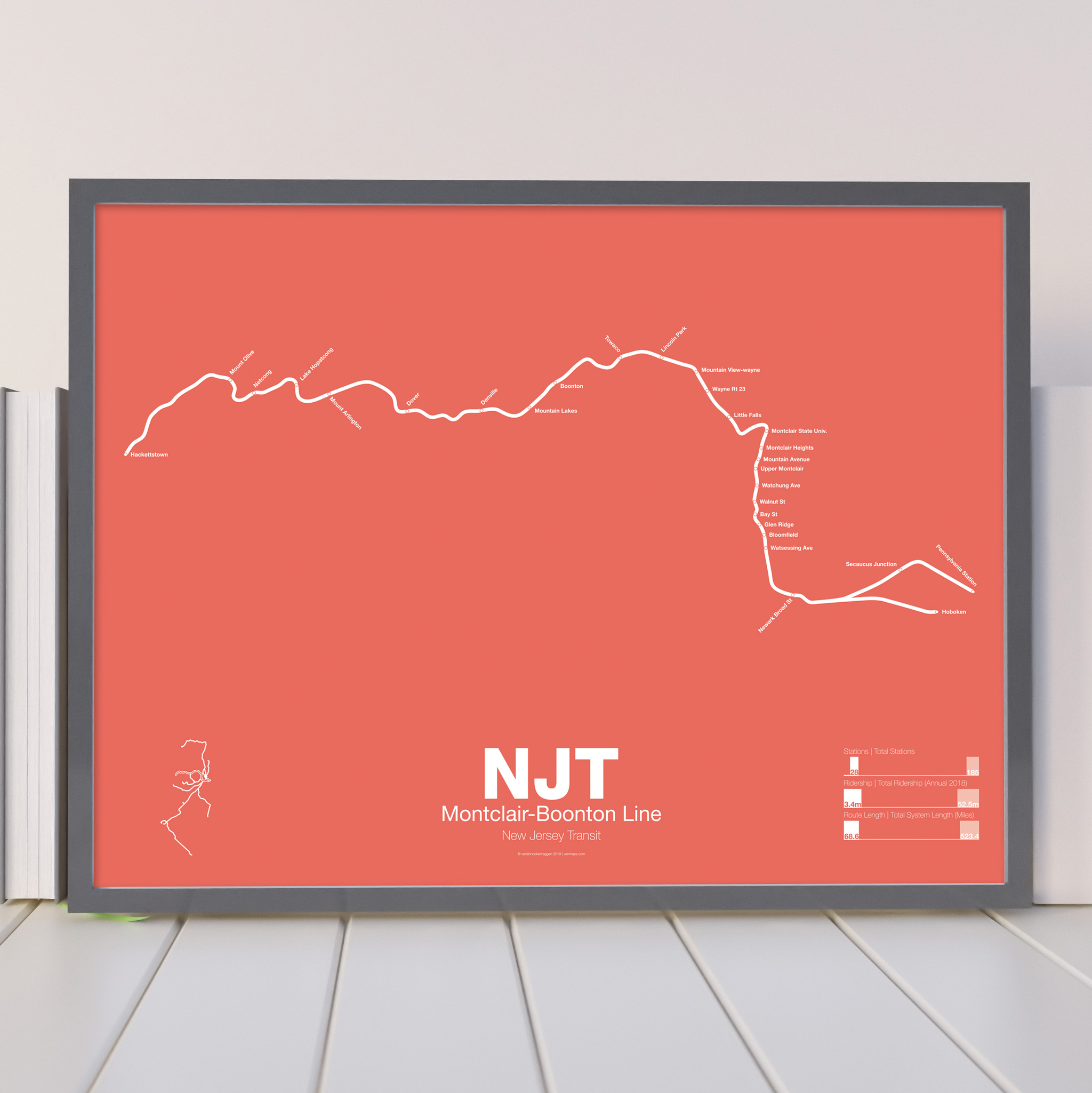
NJT Montclair-Boonton Line Poster
Price range: $30.00 through $80.00
Additional information
| Weight | N/A |
|---|---|
| Dimensions | N/A |
| Size | 18"x24", 24"x36", Framed 18" x 24" |
Related products
-
 Price range: $30.00 through $80.00
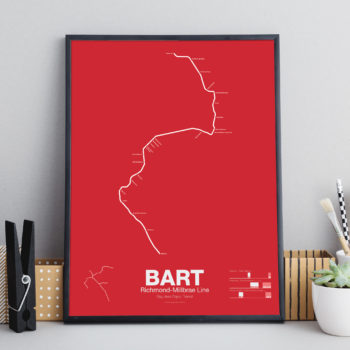
The Bay Area Rapid Transit system (BART) was, along with the WMATA in Washington D.C., one of the great centrally planned post-war rapid transit systems aimed at addressing the rise of the highway and auto-centric suburbs after World War II in the United States. Planning began in the 1950s for a unified high speed rail system that would serve both the dense inner cities of San Francisco and Oakland and their newly expanding low-rise suburbs. Stations would be spaced closer in the central business districts and further out in the suburbs.
Originally planned to connect Alameda, Contra Costa, Marin, San Francisco, and San Mateo counties BART was scaled back when San Mateo dropped out in favor of commuter rail service and the Marin line was dropped due to engineering concerns about running a rail line over the Golden Gate Bridge. Construction began in 1964 and the initial segments began to come online in 1972 and the majority of the system opening by 1974.
The Richmond-Millbrae Line, also known as the Richmond Line, was the fourth line to open in the BART system starting limited service in 1976. Because the Richmond Line shares its entire route with other BART lines it stops operations at 8pm on weekdays and 7pm on Saturdays. Originally terminating at Daly City the line was extended south in 2004 to SFO/Millbrae when that extension was opened sharing the line with the Pittsburg/Bay Point–SFO/Millbrae Line.
Printed on Satin finish 80# cover stock – 220 GSM. Made in the USA! Standard production is 5 Days. Please allow more time for shipping.
Select options This product has multiple variants. The options may be chosen on the product page -

 Price range: $30.00 through $80.00
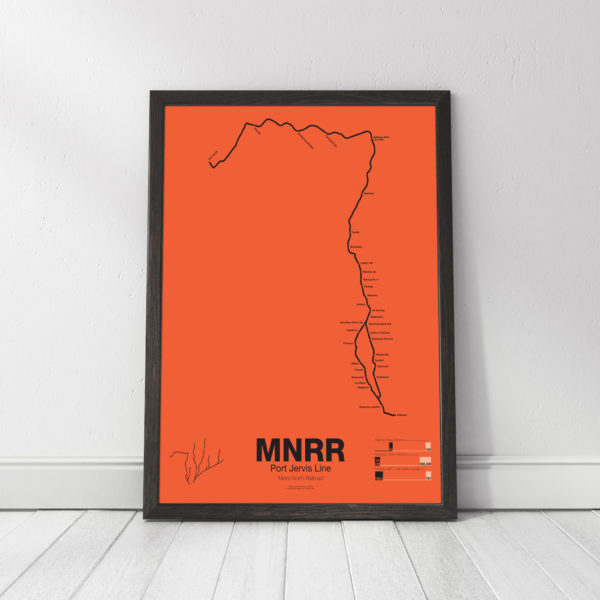
The Metro North Port Jervis Line runs from Port Jervis where Pennsylvania, New Jersey and New York meet, through Sullivan and Rockland Counties, NY, and then through northern New Jersey to the Hoboken Terminal in Hoboken, NJ. Much of the Port Jervis Line started as the New York and Erie Railroad Main Line, opening to Port Jervis in 1848. The original line ran through the towns of Monroe, Chester, Goshen, and Middletown but this stretch was abandoned in 1984 when Metro North chose to move service to a longer, but faster and straighter, route.
The Erie Main Line once reached Buffalo and Chicago via the Southern Tier of New York State but lost money and ridership after World War II. The Port Jervis Line is one of two Metro North lines which run through New Jersey. The tracks in New York are owned and operated by Metro North but the tracks in New Jersey are owned and operated by New Jersey Transit. Port Jervis trains run to Hoboken Terminal but transfers are available at Secaucus Junction for service to Penn Station.
Printed on Satin finish 80# cover stock – 220 GSM. Made in the USA! Standard production time is 5 days. Allow more time for shipping.
Select options This product has multiple variants. The options may be chosen on the product page -
 Price range: $30.00 through $80.00
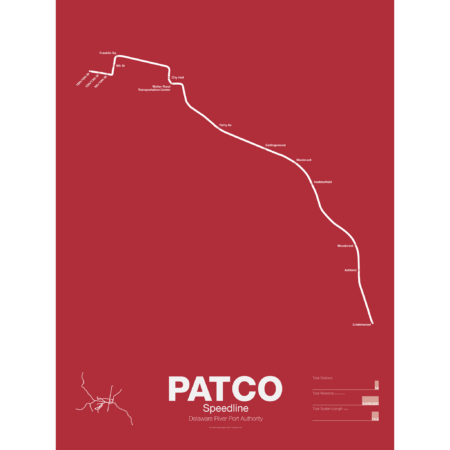
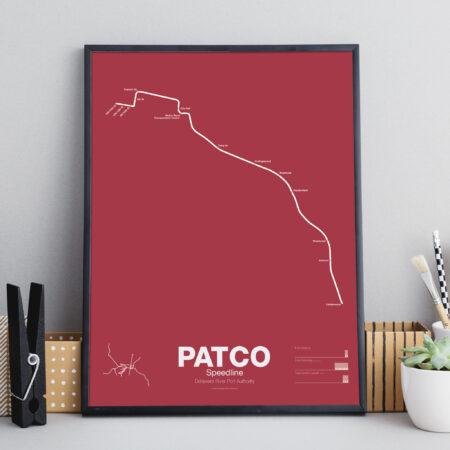
PATCO (Port Authority Transit Corp) is owned by the Delaware River Port Authority (DRPA), a separate authority than SEPTA. The line began as a simple 4 station shuttle over the newly opened Benjamin Franklin Bridge in 1936. The line ran from 8th St and Franklin Sq in Philadelphia and Broadway in Camden, NJ. On the Philly side the line connected to a tunnel which had been built for a proposed subway loop around Center City but the loop idea had been shelved after construction started. The Broad-Ridge Spur used the tunnel to reach 16th St-Locust but originally the PATCO trains terminated at 8th and Market. In 1968 the connection was rebuilt so that Broad-Ridge trains terminated at 8th St and PATCO trains were extended to 15th-16th station. This section of tunnel is still owned by SEPTA and is leased to PATCO.
On the New Jersey side PATCO had been little more than a shuttle which required suburban commuters to transfer to continue their journey. In 1951 DRPA commissioned a study which recommended 3 different branches, one to Moorestown, one to Kirkland, and one to Woodbury Heights. A later study suggested that the Kirkland route offered the most potential ridership and so PATCO was extended to Lindenwood station in 1969. PATCO continues to study expansions and has looked into extended a branch to Glassboro as well. There is an abandoned station at Franklin Sq which sees requests now and then for reactivation but PATCO claims that it wouldn’t receive high enough ridership (the area around the square was razed in the 1970s to build the Vine St and Delaware Expressways interchange.
Printed on Satin finish 80# cover stock – 220 GSM. Made in the USA! Standard production time is 5 days. Allow more time for shipping.
Select options This product has multiple variants. The options may be chosen on the product page -
 Price range: $30.00 through $80.00
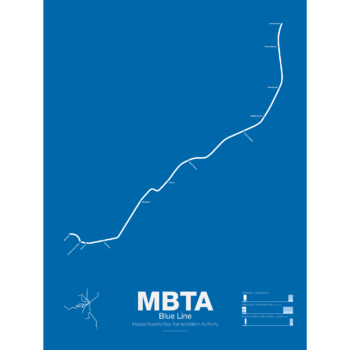
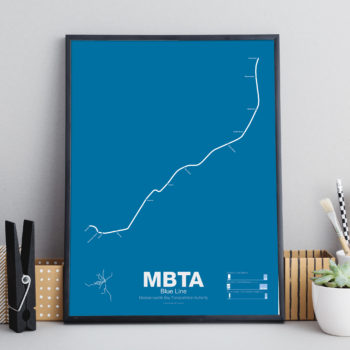
The Blue Line started off as a trolley tunnel to connect Scollay Sq. in downtown Boston to Maverick Sq. in East Boston. It holds the distinction as the first underwater transit tunnel (under a major body of water) opening in 1904. Initial plans called for it to be connected to the Green Line to form a subway trolley network connection all points north, east, south, and west. However, in 1924, the line was converted to heavy rail and extended to Bowdoin Sq. The Blue Line diverted traffic away from East Boston ferries which, ironically, helped bring the demise to the Atlantic Ave elevated line.
Until the 1950s the Blue Line was connected to the Red Line at Charles St so that Blue Line trains could be serviced at the Red Line train shops in Harvard Sq. In 1952 the Blue Line was extended to Suffolk Downs along the abandoned Boston, Revere Beach and Lynn Railroad and two years later extended to Revere where it still terminates at Wonderland.
Printed on Satin finish 80# cover stock – 220 GSM. Made in the USA! Standard production time is 5 Days. Please add more time for shipping.
Select options This product has multiple variants. The options may be chosen on the product page